When you borrow money, the real cost isn’t just the amount you take—it’s the Annual Percentage Rate (APR), which tells you the true yearly cost of borrowing, including interest and certain fees.
When you need extra funds, two options usually rise to the top: personal loans and credit cards. Both can be helpful—but depending on how you use them, the difference in interest costs can be dramatic.
At OptipWealth, we’ve helped thousands of readers understand not just what these options are, but how to choose the one that actually saves them money. In this post, we’ll break it down clearly—no jargon, just smart money talk.
1. Understanding the Basics
- A personal loan is a lump-sum amount you borrow and pay back in fixed monthly installments, usually over 1–5 years. Rates depend on your credit score, income, and lender.
- A credit card is a revolving credit line. You can borrow, repay, and borrow again—usually with no set end date. You only have to make minimum payments, but unpaid balances rack up interest fast.
💡 OptipWealth insight: Personal loans give structure. Credit cards give flexibility. The trick is knowing when each structure benefits you most.
2. Interest Rates: The Make-or-Break Factor
This is where the biggest savings—or losses—happen.
Typical APRs in 2025
| Product | Average APR (Good Credit) | Average APR (Fair Credit) |
|---|---|---|
| Personal Loan | 8% – 14% | 15% – 24% |
| Credit Card | 19% – 27% | 25% – 30%+ |
If you carry a $10,000 credit card balance at 24% APR, you’ll pay roughly $2,400 in interest annually. A personal loan at 10% APR would cost about $1,000 for the same period.
💬 Real-world example:
Sara, a freelancer from Austin, had $8,000 in credit card debt at 23% APR. By refinancing it with a 3-year personal loan at 11%, she saved nearly $2,000 in interest over the life of the loan—and finally saw a finish line.
3. Flexibility vs Discipline
Credit cards offer flexibility—you can pay the minimum, roll balances, and borrow again. But that’s also the trap. If you don’t pay in full each month, compounding interest works against you.
Personal loans, on the other hand, force structure. You borrow once, repay in fixed installments, and can’t re-borrow unless you apply again. This can be a blessing if you tend to overspend.
💡 OptipWealth insight:
“If you’re trying to break the debt cycle, structure beats flexibility every time. A personal loan gives you a fixed payoff date—a psychological edge credit cards rarely offer.”
4. Credit Impact
Both affect your credit score differently:
- Credit Cards: High balances increase your utilization ratio, which can drag down your score.
- Personal Loans: Add installment credit to your mix, which can boost credit diversity and sometimes improve your score if managed well.
Pro tip: Paying off high credit card balances with a personal loan and keeping your cards open (but unused) often leads to a credit score bump.
5. Fees, Terms, and Fine Print
Compare the total cost, not just the APR:
- Credit cards: Annual fees, penalty APRs, and balance transfer fees can add up.
- Personal loans: Origination fees (1–8%) and prepayment penalties may apply.
💡 OptipWealth insight:
Lenders love advertising “as low as” rates—but only top-tier credit scores qualify. Always check your personalized offer.
6. When a Personal Loan Makes Sense
- You have high credit card balances and want a lower fixed APR.
- You prefer fixed payments and a clear payoff timeline.
- You want to consolidate multiple debts into one.
✅ Bonus: Many lenders let you check rates without affecting your credit, making comparisons easy.
7. When a Credit Card Is the Smarter Play
- You pay balances in full monthly (and can earn rewards).
- You need short-term flexibility for emergencies.
- You qualify for a 0% intro APR offer and can pay it off before it ends.
Example: An 18-month 0% APR balance transfer could beat a loan if you’re disciplined.
8. OptipWealth’s Take
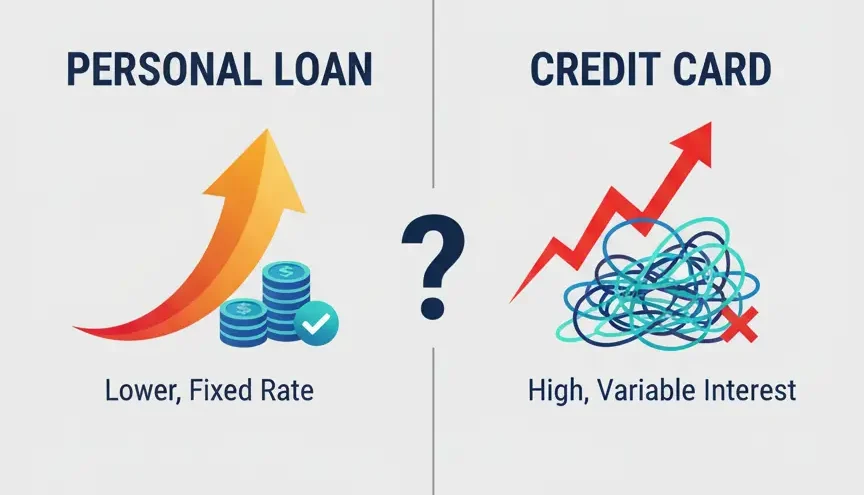
If you carry credit card debt month to month, a personal loan often wins on total interest savings. It gives structure, usually lower rates, and a clear finish line.
If you’re disciplined with payments, a credit card with a 0% APR offer or strong rewards can be a powerful tool. The key is honest self-assessment.
💬 OptipWealth perspective:
“Don’t pick based on the lowest rate alone. Pick the option that matches your habits. Financial tools don’t build wealth—your behavior does.”
Quick Comparison Table
| Feature | Personal Loan | Credit Card |
|---|---|---|
| APR | Lower fixed APR | Higher variable APR |
| Payments | Fixed monthly | Flexible, minimum |
| Payoff Date | Fixed | Open-ended |
| Credit Impact | Improves mix | High utilization can hurt |
| Best For | Debt consolidation, structure | Rewards, short-term borrowing |
Final Word
Both personal loans and credit cards have their place. The cheapest option on paper isn’t always the smartest in practice. A well-chosen personal loan can save thousands, while disciplined credit card use can maximize flexibility and rewards.
Before deciding, compare APRs, check fine print, and use trusted lender comparison tools.
Disclaimer
This article is for informational purposes only and does not constitute financial advice. Always consult a licensed financial professional before making borrowing decisions.